As an Amazon Associate, we earn from qualifying purchases. Some links on this site are affiliate links at no extra cost to you. Our recommendations are based on thorough research and editorial judgment.


How a Condensing Tankless Water Heater Differs From a Non-Condensing Model

Condensing tankless water heaters capture exhaust heat that non-condensing models release, achieving 98% efficiency versus 80% for standard units. They use two heat exchangers instead of one, allowing cooler venting through PVC pipes rather than metal ducts. While condensing models cost $1,000–$2,500 more initially, they save $3,000–$4,000 over ten years and require annual maintenance to flush mineral buildup. Understanding which model fits your climate, budget, and long-term priorities reveals significant differences in your total investment.
Key Takeaways
- Condensing models achieve 98% efficiency with dual heat exchangers, while non-condensing units operate at 80% efficiency with single exchangers.
- Condensing units vent cooler exhaust (38–90°F) through PVC pipes; non-condensing models require metal venting for hot exhaust temperatures.
- Condensing heaters cost $1,000–$2,500 more upfront but save $3,000–$4,000 over 10 years in operating expenses.
- Condensing models require annual maintenance to flush mineral buildup; non-condensing units need minimal upkeep.
- Condensing technology reduces fuel consumption and household emissions, providing greater environmental benefits than non-condensing alternatives.
Condensing vs. Non-Condensing: Efficiency Ratings and Annual Energy Costs
When you’re choosing between a condensing and non-condensing tankless water heater, one of the most important factors to take into account is how efficiently each type converts energy into hot water. Condensing models achieve up to 98% efficiency with a UEF of 0.96, capturing residual heat that would otherwise escape. Non-condensing units operate around 80% efficiency with a UEF of 0.80-0.85, wasting roughly 20% of heat through venting. These performance metrics directly affect your utility bills and lifecycle costs. Over time, condensing heaters deliver substantial energy savings despite higher upfront expenses, while non-condensing models cost less initially but result in considerably higher long-term utility expenses due to their lower efficiency ratings and greater fuel consumption.
How Heat Exchanger Design Impacts Heating Performance

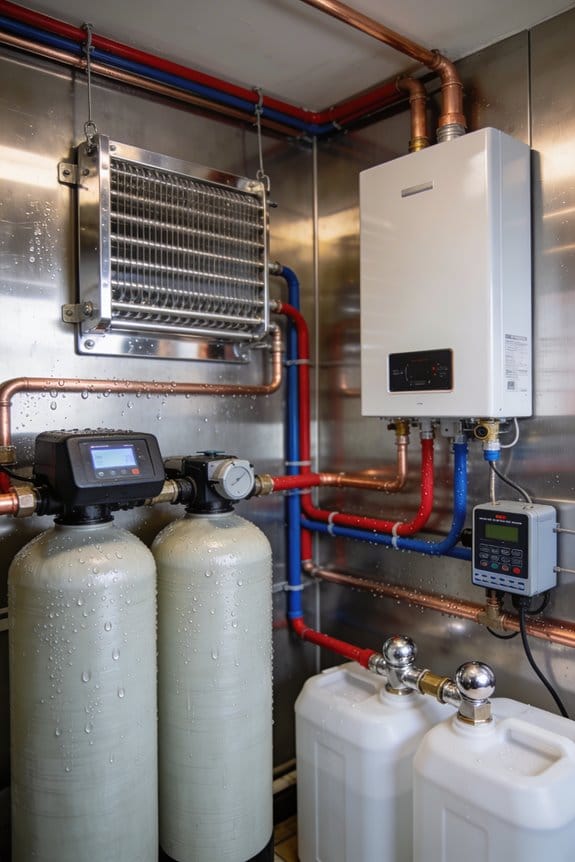
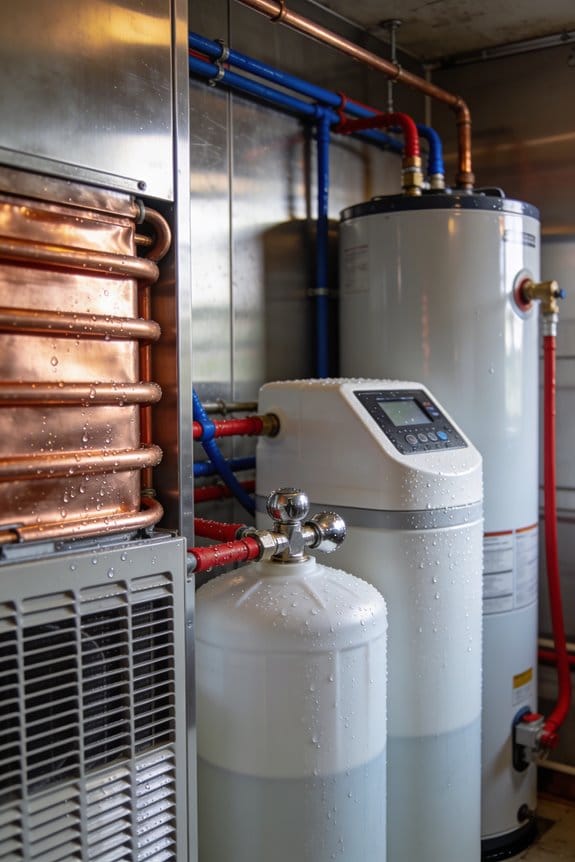
The heat exchanger is the heart of your tankless water heater, and its design fundamentally determines how efficiently the unit converts fuel energy into usable hot water. Condensing models use two heat exchangers, while non-condensing units rely on a single one. This difference dramatically affects performance. The secondary exchanger in condensing units captures residual heat from exhaust gases, pre-heating incoming water and maximizing energy capture. Non-condensing designs prioritize flow dynamics and simplicity with direct heat transfer. However, condensing exchangers demand superior material longevity through stainless steel construction to withstand corrosive condensation. Non-condensing exchangers face less stress, requiring standard materials. Understanding these design differences helps you appreciate why condensing models achieve 98% efficiency, while non-condensing units operate around 80%.
Venting: Why Condensing Models Cost Less to Install

Venting systems reveal one of the most significant cost differences between condensing and non-condensing tankless water heaters, and understanding this distinction can help you make a more informed decision during installation. Condensing models vent cooler exhaust, typically between 38-90°F, allowing you to use affordable PVC or polypropylene pipes. This material savings substantially reduces your overall installation costs. Non-condensing units, conversely, expel hot exhaust requiring expensive corrosion-resistant metal channels. Beyond affordability, condensing venting offers installation flexibility since cooler pipes can follow longer runs and varied pathways throughout your home. You’ll avoid the premium expenses associated with heat-resistant materials and complex routing restrictions that non-condensing systems demand, making condensing models financially advantageous despite higher upfront equipment prices.
Comparing Upfront Prices and 10-Year Operating Costs

While venting costs provide condensing models with an installation advantage, the real financial picture emerges when you compare both upfront prices and what you’ll actually spend over a decade of use. Condensing units typically cost $1,000–$2,500 more initially than non-condensing models, but their 98% efficiency translates to substantial energy savings. Over 10 years, a condensing model can save $3,000–$4,000 in operating costs through reduced fuel consumption. Non-condensing models appeal to budget-conscious buyers with lower upfront expenses, yet their 80% efficiency means higher monthly bills accumulate quickly. Many states offer rebate incentives for condensing models, further narrowing the price gap. Additionally, condensing units often provide better resale value, making them a smarter long-term investment despite higher initial costs.
Maintenance Reality: What Condensing Models Require Annually

Because condensing water heaters capture and recycle exhaust heat, they generate condensation that you’ll need to manage annually to keep your system running smoothly. I recommend scheduling annual flushing to remove mineral buildup, which extends your unit’s lifespan. Additionally, condensate testing guarantees your drainage system functions properly, preventing water damage or corrosion inside the heat exchanger. You’ll drain and neutralize acidic condensation water before it exits your system, protecting both your equipment and plumbing. While this maintenance sounds involved, it’s straightforward when performed yearly by professionals or knowledgeable homeowners. Non-condensing models, by contrast, require minimal upkeep since they don’t produce condensation. Think of condensing maintenance as preventive care that pays dividends through improved efficiency and durability over your heater’s lifetime.
Climate and Water Temperature: Which Model Works for Your Region?
Your region’s climate and groundwater temperature are critical factors in determining which tankless water heater model will serve you best. Condensing models excel in colder climates where groundwater temperatures drop markedly, since they capture residual heat efficiently. Non-condensing units perform better in warmer regions with higher groundwater temperatures, requiring less energy to reach desired heating levels. Seasonal usage patterns affect your choice too; condensing models handle demanding winter demands effectively. Regional mineralogy influences maintenance considerations, as hard water areas require more frequent descaling regardless of model type. I’d recommend evaluating your local water temperature averages and climate zone before deciding. Colder regions benefit from condensing technology’s superior efficiency, while warmer areas may find non-condensing models adequate and more cost-effective initially.
Beyond the Bottom Line: Lower Emissions as a Secondary Benefit
When you’re comparing tankless water heaters, the upfront costs and long-term energy savings often dominate the conversation, but there’s another important consideration worth examining: environmental impact. Condensing models reduce fuel consumption markedly, which directly lowers your household’s emissions accounting. Because they capture residual heat that non-condensing units waste through venting, condensing heaters burn less gas to produce the same amount of hot water. Over time, this efficiency advantage translates into a smaller lifecycle footprint for your home. While environmental benefits shouldn’t be your only deciding factor, they’re worth considering alongside financial savings. If you’re environmentally conscious, condensing technology offers a meaningful way to reduce your household’s greenhouse gas contributions without sacrificing performance or comfort.
Condensing or Non-Condensing? How to Match Your Priorities to the Right Choice
Deciding between condensing and non-condensing tankless water heaters requires you to honestly assess what matters most in your situation. If you’re prioritizing long-term savings and environmental impact, condensing models offer superior efficiency despite higher upfront costs. However, if your budget is tight and you live in a warm climate, non-condensing units provide reliable performance with minimal maintenance demands. Consider installation logistics carefully; condensing models need PVC venting and condensate drainage, while non-condensing units require metal venting that increases installation expenses. Review warranty considerations too, since condensing heat exchangers often carry longer coverage due to their complex design. Ultimately, your climate, budget, and maintenance willingness should guide your decision.
Frequently Asked Questions
Can Condensing Models Handle Hard Water, and Does Mineral Buildup Affect Performance?
I’d tell you that condensing models can handle hard water, but you’ll need diligent scale management. Mineral buildup affects performance in both types, so regular descaling and water treatment protect your unit’s efficiency.
What Is the Lifespan Difference Between Condensing and Non-Condensing Tankless Water Heaters?
I’d say condensing models typically last 20-25 years versus non-condensing’s 15-20 years. You’ll find condensing units often carry longer warranties, reflecting their durability despite higher maintenance demands.
Do Condensing Units Require Special Drainage Systems for Acidic Condensate Water?
Yes, I’ve found condensing units need special drainage for acidic condensate. They include internal filtration for secondary neutralization before acidic disposal, protecting your plumbing from corrosion damage.
How Do Retrofit Installation Challenges Differ Between Condensing and Non-Condensing Models?
I’d say condensing models present greater venting complexity since they need PVC piping that runs longer distances, while non-condensing units demand heat-resistant metal channels. Space constraints matter too—condensing’s secondary exchanger requires more room.
Are There Noise Level Differences Between Condensing and Non-Condensing Tankless Systems?
I’ll tell you straight—condensing models sound like a jet engine compared to non-condensing units. That’s because I’ve found their fan noise and combustion hum create noticeably louder operation, though you’re gaining serious efficiency benefits.