As an Amazon Associate, we earn from qualifying purchases. Some links on this site are affiliate links at no extra cost to you. Our recommendations are based on thorough research and editorial judgment.

Salt-Based vs. Salt-Free Water Softener: Which Should You Choose?

salt-based softeners remove up to 99% of hardness minerals, making your water truly soft, but they cost $500–$3,000 upfront, require monthly salt refills, and add sodium to your water. Salt-free conditioners prevent about 70% of scale buildup, cost less initially, need only cartridge replacements every 3–5 years, and skip the maintenance hassle. Your water hardness level determines which works best; test yours first to discover which option fits your specific situation.
Key Takeaways
- Salt-based softeners remove 99% of hardness minerals; salt-free conditioners prevent only 70% of scale buildup.
- Salt-based systems cost $500–$3,000 upfront plus $100 annually for salt; salt-free units cost $300–$1,600 initially.
- Salt-based systems require monthly salt replenishment and storage space; salt-free systems need cartridge replacement every 3–5 years.
- Choose salt-based for water hardness above 10 gpg; salt-free works best for moderate hardness between 5–10 gpg.
- Salt-based systems require drain access and produce brine wastewater; salt-free units fit most installations without environmental concerns.
How Do Salt-Based and Salt-Free Softeners Work?
Understanding how water softeners function requires us to examine two fundamentally different approaches to handling hard water. Salt-based softeners use ion exchange, a process where calcium and magnesium ions get replaced with sodium ions, effectively removing hardness minerals from your water. These systems regenerate using brine solution, which flushes away the collected minerals as wastewater.
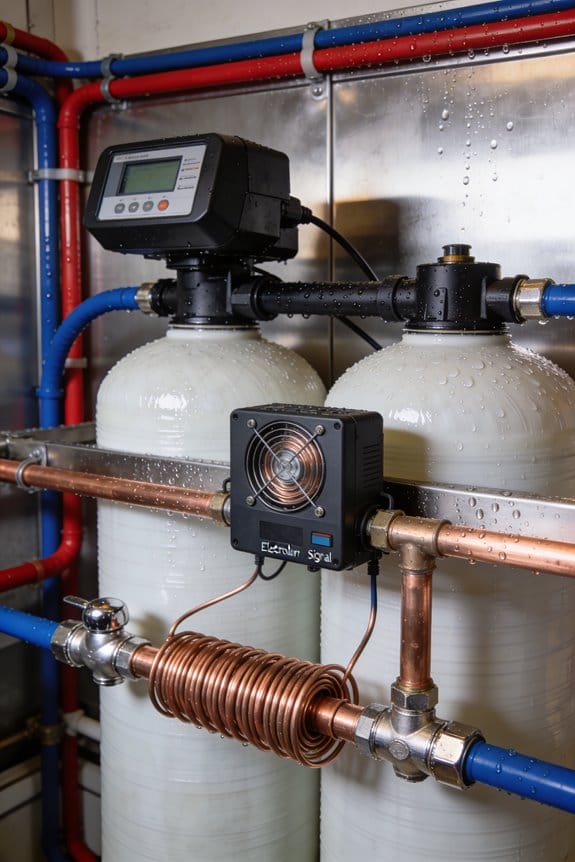
Salt-free conditioners work differently through crystal seeding, also called template-assisted crystallization. Rather than removing minerals, they alter the mineral structure so it won’t stick to pipes and appliances. This passive system requires no regeneration or electricity, making it simpler operationally. However, minerals remain in your water in altered form, so you’re not technically getting soft water—you’re preventing scale buildup instead.
Salt-Based Systems: Complete Hardness Removal at a Cost

Salt-based water softeners tackle hard water through a proven method called ion exchange, which removes calcium and magnesium minerals entirely rather than just altering them. During the regeneration cycle, resin beads inside the tank exchange hardness minerals for sodium ions, effectively softening your water. This process produces wastewater containing the removed minerals, which drains away. When the resin becomes saturated, the system triggers a regeneration cycle using brine solution to restore the resin’s effectiveness. Eventually, resin replacement becomes necessary, typically after several years of use. While this approach delivers superior hardness removal—eliminating up to 99% of minerals—it does add water sodium to your supply. Salt-based systems excel for extremely hard water situations where complete mineral removal is necessary for peak performance.
Salt-Free Conditioners: Scale Prevention Without Full Softening

While salt-based systems remove hardness minerals entirely, salt-free conditioners take a different approach by preventing scale buildup without actually softening your water. Instead of eliminating minerals, these systems use template-assisted crystallization to transform them into non-adhesive crystals. This crystal transformation prevents minerals from sticking to pipes and appliances, which enhances appliance longevity and reduces maintenance headaches. You’ll still have minerals in your water, but they won’t accumulate as damaging scale. Salt-free conditioners work passively without regeneration or electricity, making them simpler to maintain. They’re particularly valuable in areas where brine discharge restrictions exist. However, they’re most effective for moderate hardness levels, preventing roughly 70% of scale buildup. If you have very hard water, they may not provide sufficient protection.
What You’ll Pay: Installation, Salt, and Cartridge Costs

When you’re deciding between salt-based and salt-free systems, the price tag matters as much as the technology itself. Salt-based softeners typically cost $500–$3,000 upfront, with installation averaging $1,500. You’ll then spend roughly $100 annually on salt replenishment. Salt-free conditioners range from $300–$1,600 initially, with installation costs varying between $800–$4,000 depending on your home’s size. However, they require cartridge replacements every 3–5 years instead of ongoing salt purchases. When considering installation financing options, salt-free systems offer lower monthly expenses. For long-term resale value, homes with salt-based systems appeal to buyers in hard water regions, while salt-free installations attract environmentally conscious purchasers. Calculate your five-year costs before deciding.
Maintenance and Upkeep: Which System Requires Less Work?

Beyond the initial investment and yearly expenses, how you’ll actually maintain your water softener plays a significant role in your decision. Salt-based systems demand consistent attention, requiring monthly salt replenishment and weekly to biweekly checks to make certain proper regeneration cycles. You’ll need storage space for heavy salt bags and regular monitoring of system performance. Salt-free systems offer simpler maintenance with significantly lower maintenance frequency. Their primary upkeep involves cartridge replacement every three to five years, eliminating the burden of handling consumables like salt. Since salt-free conditioners operate passively without regeneration cycles, you’ll spend less time on routine checks. For homeowners seeking convenience and minimal hands-on care, salt-free systems clearly require less work, making filter disposal your only substantial maintenance task.
Which Water Hardness Level Matches Your Home?
How do you know whether your home needs a salt-based softener or a salt-free conditioner? The answer lies in testing your water’s hardness level. I’d recommend starting with testing methods like at-home kits or professional lab analysis, which measure hardness in grains per gallon (gpg). Regional standards vary markedly; some areas experience mild hardness around 3-6 gpg, while others face severe levels exceeding 15 gpg. If your water tests above 10 gpg, a salt-based softener removes 99% of minerals effectively. For moderate hardness between 5-10 gpg, salt-free systems prevent sufficient scale buildup. Understanding your specific water composition helps determine which system matches your home’s actual needs.
Choosing the Right Water Softener for Your Situation
Selecting between a salt-based softener and a salt-free conditioner depends on balancing your water’s hardness level, budget, environmental concerns, and maintenance preferences. Start with water testing to determine your hardness level, which guides your choice. If you’ve got very hard water above 15 gpg, salt-based systems remove 99% of minerals, making them ideal. For moderate hardness, salt-free options prevent 70% scale buildup affordably. Consider your plumbing compatibility too—salt-based systems need drain access, while salt-free units fit most installations. Evaluate ongoing costs: salt-based require monthly salt purchases, whereas salt-free need cartridge replacements every 3-5 years. If you live in eco-restricted areas, salt-free avoids brine wastewater issues. Match your choice to what matters most: complete softening or low-maintenance prevention.
Frequently Asked Questions
Are Salt-Based Softeners Restricted or Banned in My Area Due to Environmental Regulations?
I can’t tell you definitively—like checking a map without knowing your location—but I’d recommend checking your local ordinances. Many areas restrict salt-based softeners due to wastewater restrictions on brine discharge.
Will a Salt-Based Softener Increase Sodium Levels Enough to Affect My Health?
You’ll add roughly 30mg sodium per 8oz serving at 18 gpg hardness—minimal for most people. However, if you’re sodium-restricted, I’d consider salt-free. It won’t affect dishwasher performance.
Can Salt-Free Systems Work Effectively if My Water Hardness Is Extremely High?
I’d be barking up the wrong tree recommending salt-free for extremely hard water. They’re not equipped like ion exchange systems—template assisted crystallization prevents only 70% scale, whereas salt-based removes 99% hardness minerals effectively.
How Often Should I Test My Water to Ensure My Softener Is Working?
I’d recommend monthly testing of your water hardness to monitor softener performance, with an annual inspection of the system itself. This guarantees you’re catching any drops in effectiveness early and maintaining peak operation.
Do Salt-Based Softeners Require a Separate Drain Line for Brine Wastewater?
Yes, like a river needing its own channel, salt-based softeners require separate plumbing requirements for brine disposal. You’ll need a dedicated drain line directing wastewater away from your home’s standard system.